AI's Dual Impact on Employment: Job Losses Mount, New Skills Emerge
The transformative power of AI is creating a complex labor market, as evidenced by recent layoffs at Uber and Patreon, attributed in part to increased AI i
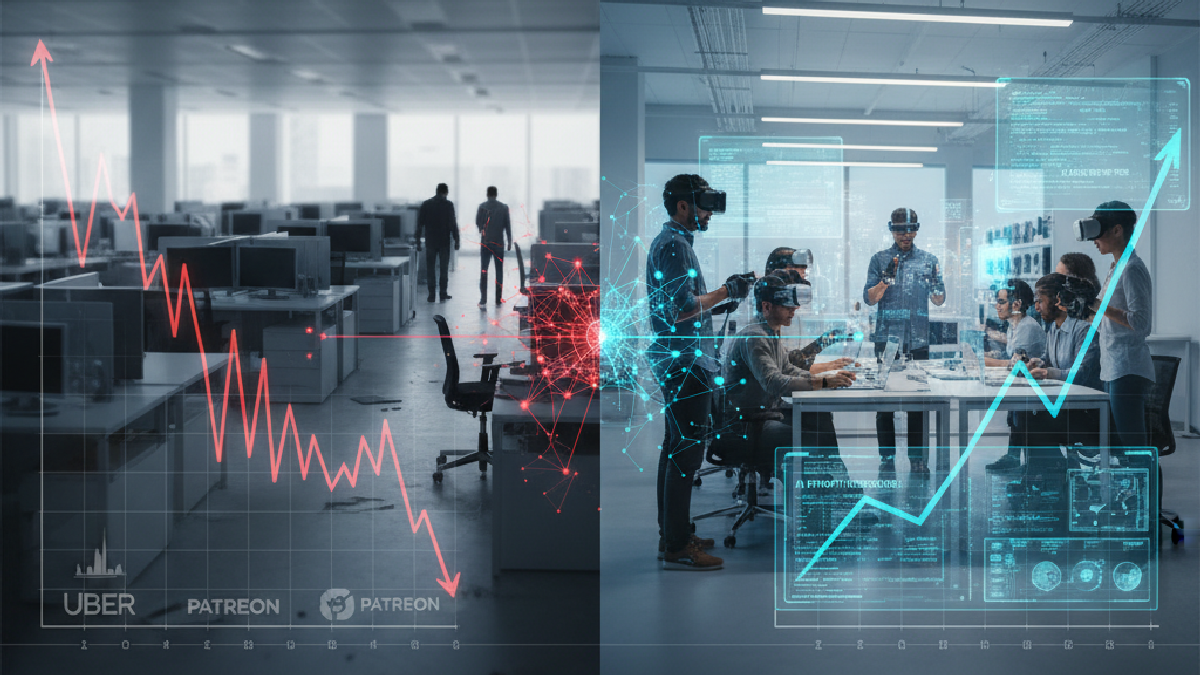
AI Reshapes the Workforce: A Tale of Two Realities
Artificial intelligence, long heralded as a revolutionary force, is now overtly demonstrating its dual impact on employment: displacing existing jobs while simultaneously creating new frontiers for skilled labor. Recent announcements from major tech players like Uber and Patreon highlight the increasing trend of layoffs directly linked to AI's enhanced capabilities. This phenomenon isn't merely a blip; it represents a fundamental reshaping of the global workforce, where the chasm between those with relevant AI skills and those without is rapidly widening.
Layoffs Link Directly to AI Efficiency Gains
The past few days have brought sobering news from companies integrating AI more deeply into their operations:
- Uber: Significantly, Uber is reportedly laying off 10% of its customer service workforce as it continues to "embrace AI." This move is a stark illustration of how AI-powered chatbots and automated systems can handle routine customer inquiries more efficiently, reducing the need for human agents. While improving customer experience and cost-effectiveness for the company, it directly impacts human employment.
- Patreon: The creator platform Patreon has announced a significant 20% workforce reduction. While not solely attributed to AI, the broader trend in tech often sees AI automation playing a role in streamlining operations and reducing overheads, especially in customer support, content moderation, and administrative tasks.
These examples underscore a growing economic reality: as AI models become more sophisticated – capable of handling complex queries, drafting communications, and supporting operational workflows – roles traditionally performed by humans are being automated. Even as Claude codes 3x faster, companies are navigating a complex transition where human experience and automated speed must coexist. "This isn't just about simple task automation anymore; it's about AI agents performing multi-step reasoning and problem-solving, which has a much broader impact on what human roles are required," explains a leading AI ethicist.
The Rise of AI Agents and Their Implications
The concept of "AI agents" – autonomous AI systems capable of executing a sequence of tasks to achieve a goal – is rapidly evolving. OpenAI's recent advancements with GPT-Live, now brought to the ChatGPT desktop app, allow users to vocalize complex instructions for tasks like scheduling and email drafting. Similarly, their new platform Presence aims to simplify the deployment and management of real-time voice agents and chatbots for enterprises. While these innovations promise unprecedented productivity boosts, AI agents take center stage as both powerful business boosters and potential security challenges.
AI Agent Capabilities include:
- Full-Duplex Voice Interaction: Systems that can listen and speak simultaneously, mimicking natural conversation.
- Task Automation: From drafting emails to calendar management and even coding assistance.
- Real-time Problem Solving: Leveraging access to vast information bases and internal systems to resolve issues without human intervention.
The Pivotal Role of Adaptability and AI Literacy
While some jobs are being shed, the demand for new, highly specialized AI skills is simultaneously exploding. Companies are desperately seeking talent capable of not just developing AI, but also managing, integrating, and fine-tuning these complex systems. The AI talent wars reignite as tech giants compete for specialists and intellectual property. Roles such as AI prompt engineers, AI ethicists, data scientists, machine learning engineers, and AI integration specialists are seeing unprecedented demand and compensation.
The labor market is bifurcating: on one side, roles susceptible to automation face increasing pressure; on the other, opportunities for those who can work alongside, manage, or develop AI systems are booming. The critical takeaway for individuals and educational institutions is the urgent need for upskilling and reskilling in AI literacy, critical thinking, and complex problem-solving unique to human capabilities.
Policy and Ethical Considerations
The rapid shift in employment due to AI necessitates urgent conversations about policy. The potential for widespread economic disruption, if not managed proactively, could have severe societal consequences. Governments and policymakers are beginning to grapple with this, as seen with proposals like the "AI Kill Switch Act" in the US, aimed at mitigating risks from rogue AI systems. However, proactive labor market policies, investments in lifelong learning, and social safety nets will be crucial to navigate this transition successfully.
In conclusion, AI's impact on jobs is not a monolithic force of destruction, but rather a powerful reorganizer. It's eliminating some roles and creating others at an accelerated pace. The challenge for individuals, businesses, and governments alike is to embrace this change, foster continuous learning, and ensure an equitable transition into an AI-augmented future.