Nvidia's Bold $3.5B MediaTek Gambit: Powering the Next AI Wave Beyond Big Tech
Nvidia's strategic $3.5 billion investment in MediaTek signals a profound shift in its AI chip strategy, moving beyond its traditional data center strongho
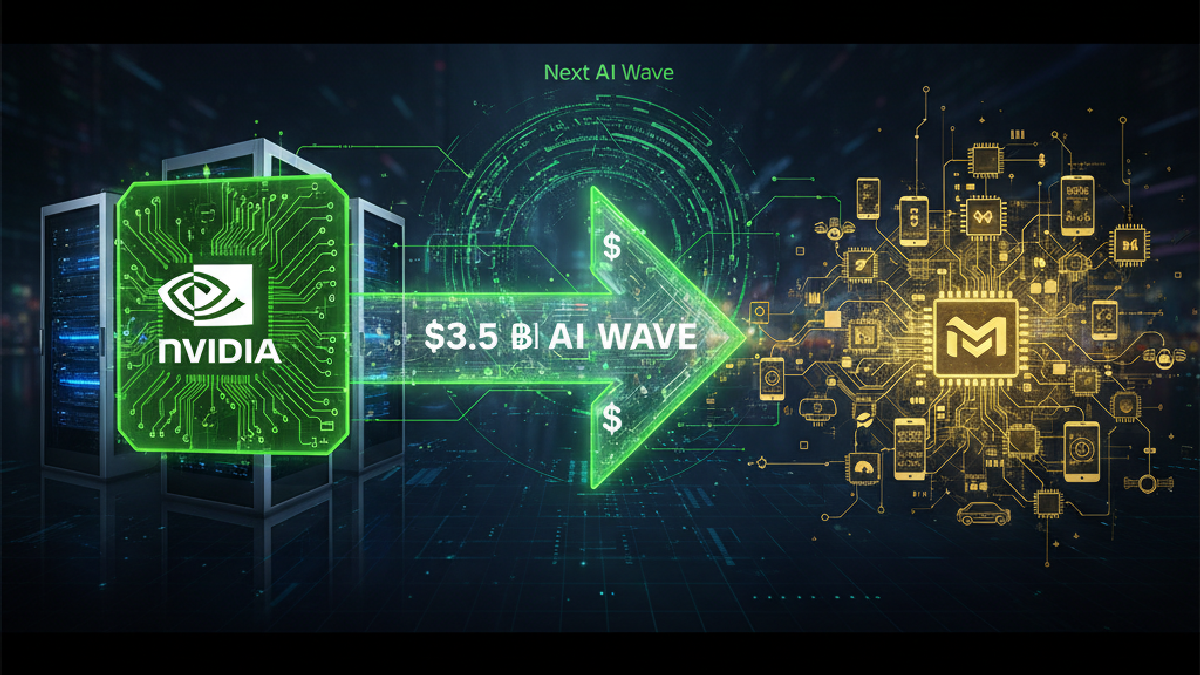
Nvidia's Strategic Shift: A $3.5 Billion Bet on Ubiquitous AI
Nvidia, a company synonymous with GPU innovation and the backbone of today's AI revolution, is making a bold move that could redefine the landscape of AI hardware. Its recent $3.5 billion investment in MediaTek is not merely a financial transaction; it's a profound strategic declaration. This substantial bet signals Nvidia's intent to broaden its influence beyond the high-end data centers where its GPUs currently reign supreme, aiming for a more ubiquitous presence across a vast array of devices and emerging markets.
For years, Nvidia has capitalized on the insatiable demand for computational power, particularly from large tech companies and cloud providers training massive AI models. However, this reliance on a few dominant players also presents a vulnerability. As hyperscalers like Google, Microsoft, and Amazon increasingly design their own custom AI chips, Nvidia faces the prospect of diminishing returns in its core market. The MediaTek partnership offers a powerful counter-narrative, positioning Nvidia to power AI where it hasn't before.
Democratizing AI: Expanding Beyond the Cloud Giants
The core of this strategy lies in democratizing access to high-performance AI. MediaTek, a global leader in chipsets for mobile devices, smart TVs, and IoT, provides Nvidia with an unparalleled gateway into consumer electronics and embedded systems. By integrating Nvidia's sophisticated AI IP (intellectual property) with MediaTek's cost-effective and energy-efficient designs, the duo can create powerful, localized AI solutions.
- Edge AI Acceleration: Imagine smartphones, smart home devices, and industrial robots performing complex AI tasks with unprecedented speed and efficiency directly on the device, reducing latency and reliance on cloud infrastructure.
- New Market Penetration: This collaboration opens doors to lucrative sectors like automotive infotainment, intelligent robotics, and advanced IoT, where AI capabilities are increasingly critical.
- Diversified Revenue Streams: For Nvidia, it’s a proactive measure to diversify its revenue, lessening dependence on a potentially consolidating data center market.
This move is particularly prescient given the rise of local and edge AI, exemplified by initiatives from companies like Apple and Perplexity AI pushing AI workloads onto devices. Nvidia, through MediaTek, can now play a significant role in this decentralized future.
The Mechanics of Collaboration: How It Will Work
While specific product roadmaps remain under wraps, the investment suggests a deep technological integration. MediaTek's expertise in System-on-Chip (SoC) design, power management, and manufacturing scale will complement Nvidia's prowess in GPU architecture, AI software stacks (like CUDA), and neural network optimization. This synergy could lead to:
- Custom AI Accelerators: MediaTek SoCs could feature dedicated Nvidia Tensor Cores or other AI processing units, delivering cutting-edge performance.
- Optimized Software Stacks: Nvidia's software ecosystem could be tailored for MediaTek's hardware, ensuring developers can seamlessly deploy AI models on these new platforms.
- Enhanced Performance-per-Watt: A focus on efficiency will be paramount for edge devices, where battery life and thermal management are critical constraints.
“Our investment in MediaTek is a testament to our belief in a future where AI permeates every aspect of technology, from the data center to the smallest edge device,” stated a fictional Nvidia executive, underscoring the long-term vision behind this partnership. Analysts at firms like Gartner and IDC project the edge AI market to grow exponentially, reaching hundreds of billions of dollars within the next five years, making this an incredibly timely intervention by Nvidia.
Competitive Landscape and Future Implications
Nvidia's move sends a clear message to competitors. Qualcomm, with its Snapdragon platforms, has long been a dominant force in mobile and edge AI. Intel and AMD are also aggressively pursuing edge AI opportunities. This Nvidia-MediaTek alliance creates a formidable new contender, potentially accelerating innovation and intensifying competition in the fragmented edge AI market.
Furthermore, it highlights a broader industry trend: the modularization and specialization of AI hardware. Instead of monolithic solutions, we are seeing a shift towards highly optimized, domain-specific AI accelerators tailored for specific use cases and form factors. Nvidia's bet on MediaTek is an endorsement of this future, where its intellectual property can be licensed and integrated into diverse silicon platforms, rather than solely relying on its own manufactured GPUs.
In essence, Nvidia is not just selling chips; it's selling an AI ecosystem. By partnering with MediaTek, it ensures that its AI DNA – from hardware architecture to software libraries – will be woven into the fabric of countless devices, securing its relevance in an increasingly diversified and decentralized AI world. This is not just about market share; it's about shaping the future of AI at scale, ensuring Nvidia remains indispensable, even as the industry evolves beyond its current paradigms.
For businesses and developers, this could mean access to a new generation of powerful, efficient, and affordable AI hardware, unlocking possibilities for innovative applications across a spectrum of industries. The $3.5 billion isn't just an investment in MediaTek; it's an investment in a future where Nvidia's AI touches everything.
Forrás: TechCrunch