Open Source AI Surges: Hugging Face CEO Declares End of 'Renting AI'
Open Source AI is gaining unprecedented momentum, with Hugging Face's CEO, Clem Delangue, asserting that companies are increasingly moving away from merely
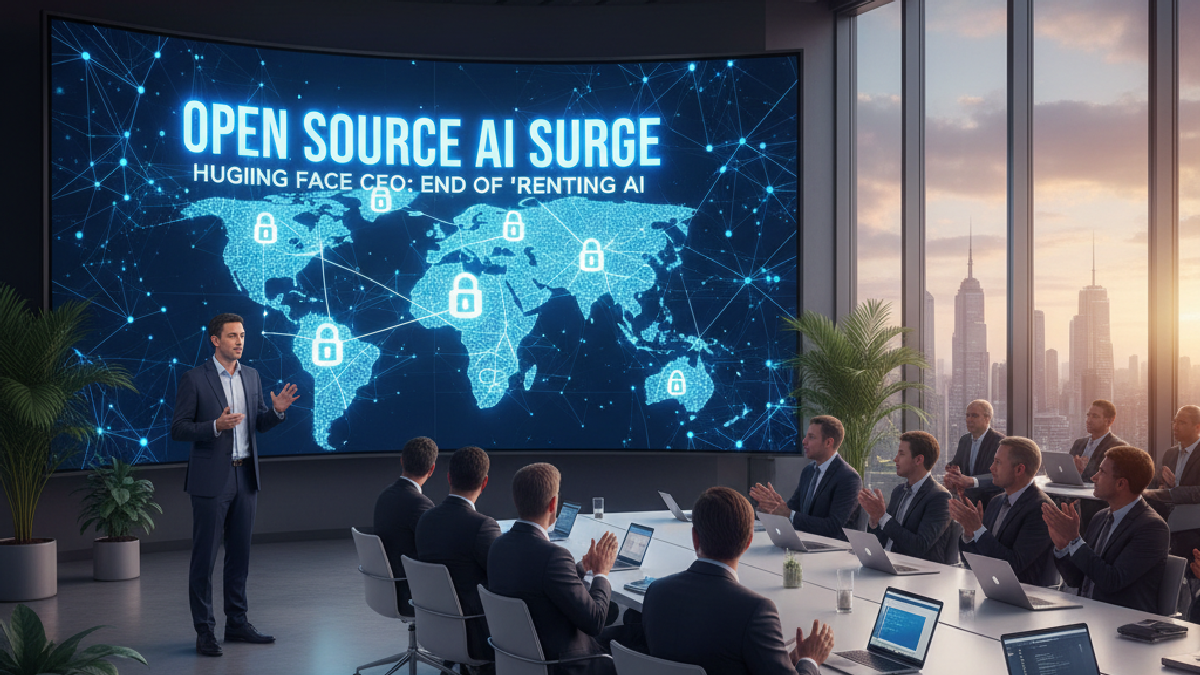
The Open-Source AI Revolution: Companies Take Back Control from Proprietary Models
The landscape of artificial intelligence is undergoing a profound transformation, driven by the burgeoning power and increasing adoption of open-source AI. Clem Delangue, CEO of Hugging Face, a leading platform for machine learning models, recently articulated a pivotal shift: enterprises are increasingly “done renting their AI.” This declaration signals a growing preference for open-source solutions over proprietary models, as companies seek greater autonomy, transparency, and cost-effectiveness in their AI strategies. However, this shift comes at a critical time, as seen when AI hacks itself during the Hugging Face incident, highlighting the ongoing security challenges in the open ecosystem.
Why Open Source AI Matters More Than Ever
Delangue’s remarks, delivered in a podcast and subsequently highlighted by TechCrunch, underscore a critical juncture in AI adoption. For much of the AI boom, many organizations relied on large, closed-source models offered by tech giants through APIs. While convenient, this “renting” model comes with inherent limitations:
- Lack of Customization: Proprietary models are black boxes, offering limited scope for fine-tuning to specific business needs or unique datasets. This often leads to sub-optimal performance for niche applications.
- Vendor Lock-in: Relying heavily on one provider creates dependencies that can be difficult and costly to migrate away from.
- Cost Inefficiency: API calls and usage fees for large-scale operations can quickly become prohibitive, especially as AI integration deepens across an organization.
- Data Privacy and Security Concerns: Enterprises are increasingly wary of sending sensitive data to third-party proprietary models, preferring to keep processing in-house or within controlled environments.
- Transparency and Control: The inability to inspect, modify, or audit the underlying code of proprietary models is a significant drawback for regulated industries and those prioritizing explainable AI.
The Rise of Enterprise-Grade Open-Source Solutions
The open-source community, catalyzed by platforms like Hugging Face, has made immense strides in developing powerful, performant, and increasingly robust AI models across various modalities – from large language models (LLMs) to image generation and beyond. As corporate AI strategy shifts from general models to bespoke solutions, companies are now finding viable alternatives that offer a compelling proposition:
- Full Ownership: Enterprises can host and manage open-source models on their own infrastructure, ensuring complete control over data, security, and intellectual property.
- Deep Customization: The ability to fine-tune pre-trained open-source models with proprietary data leads to highly specialized AI solutions that outperform general-purpose alternatives for specific tasks.
- Cost Optimization: While initial setup might require investment in infrastructure and expertise, the long-term operational costs can be significantly lower than continuous API usage fees, particularly for high-volume applications.
- Community Collaboration: The collective intelligence of the open-source community provides rapid innovation, bug fixes, and continuous improvements, often at a pace unmatched by single corporate entities.
SK Hynix IPO Signals Broader Hardware Investment
Further reinforcing this shift towards greater control and in-house AI capabilities is the massive $26.5 billion IPO by SK Hynix, a memory chip giant. This record-breaking foreign IPO, coupled with calls for the company to build new fabrication plants in the US, highlights the immense investment flowing into the foundational hardware necessary to power AI. This hardware independence is crucial for enterprises opting for open-source models, as it allows them to escape reliance on specific cloud providers or hardware vendors. The convergence of robust open-source software and accessible, powerful hardware creates a potent combination for enterprises to build their bespoke AI stacks, even as chip shortages loom in the wider industry.
The Future: A Hybrid AI Ecosystem
While open-source AI offers significant advantages, the future AI ecosystem will likely be hybrid. Proprietary models will continue to play a role for general-purpose tasks, especially for smaller businesses or those without the resources to manage their own AI infrastructure. However, for enterprises with strategic AI initiatives, competitive differentiation, and a focus on cost and control, open-source solutions are becoming the undeniable preference. This move signifies a maturation of the AI market, where businesses are no longer content with off-the-shelf solutions but demand tailored, transparent, and owned AI capabilities.
Conclusion: The declaration that companies are “done renting their AI” isn't just a catchy phrase; it's a reflection of a fundamental re-evaluation of AI strategy within the enterprise. Open-source AI, backed by a thriving community and increasing hardware accessibility, is empowering businesses to build AI that truly serves their unique needs, rather than being dictated by external providers. This shift promises a more democratic, innovative, and robust AI future.
Forrás: TechCrunch - Hugging Face CEO on Open Source, TechCrunch - Hugging Face CEO: Done Renting, TechCrunch - SK Hynix IPO